


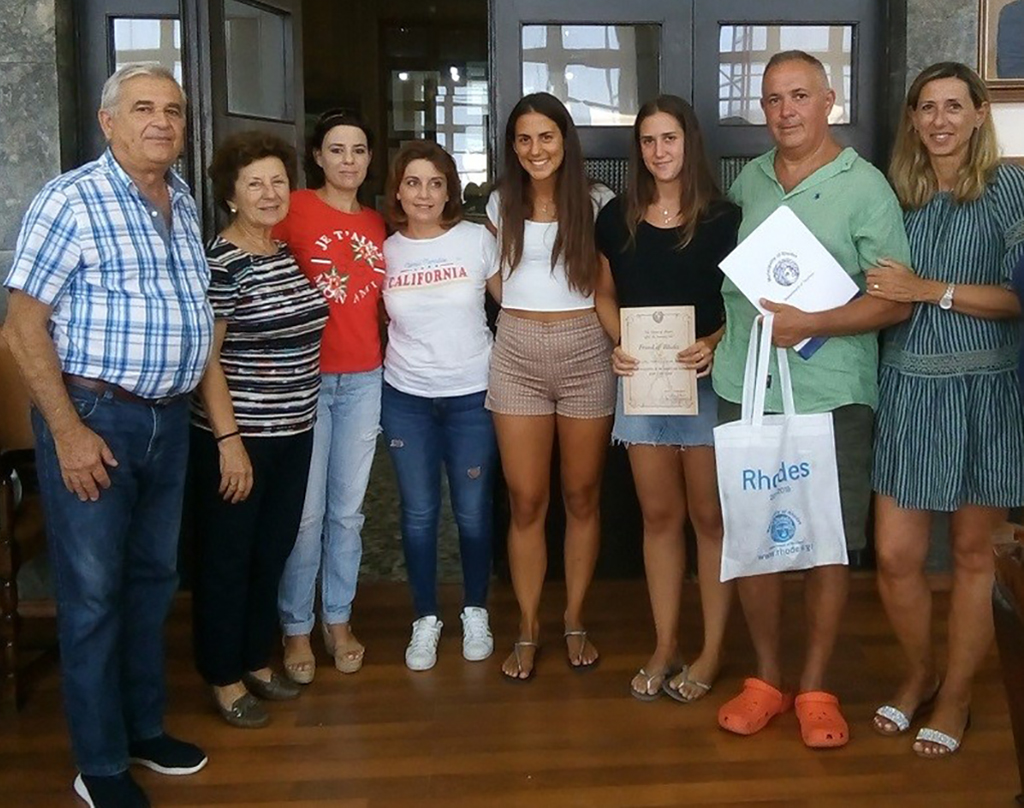
Αρθρο της Ιταλίδας Διδάκτορος Νομικής Elisa Fallani που λατρεύει τη Ρόδο
Η λατρεία του Ιταλού πατέρα της και όλης της οικογένειας της για τη Ρόδο, που είχαν επισκεφθεί περισσότερες από 30 φορές, αλλά και οι πρώτες όμορφες δικές της, παιδικές και αργότερα εφηβικές, εικόνες και αναμνήσεις, από τα ταξίδια της στο νησί, στάθηκαν για την Elisa Fallani η αρχική αιτία για να εκπονήσει εργασία με θέμα «Μεσαιωνική Πόλη της Ρόδου – Παγκόσμια Πολιτιστική Κληρονομιά: Άυλη, κρυμμένη, πολύτιμη αξία», θέμα ξεκάθαρα δικής της επιλογής, στο πλαίσιο του μεταπτυχιακού της με τίτλο «Διαχείριση και Διατήρηση της Παγκόσμιας Πολιτιστικής Κληρονομιάς» στο Πανεπιστήμιο της Φλωρεντίας στην Ιταλία.
Μετά δε και τον πρόσφατο θάνατο του πατέρα της David Fallani από κορωνοϊό η απόφαση της να γράψει ένα μικρό αφιέρωμα για το αγαπημένο νησί της οικογένειας ενισχύθηκε και προχώρησε στη συγγραφή της συγκεκριμένης εργασίας.
«Είναι ένα δώρο από τη δική μου πλευρά, στη Ρόδο, στην ελληνική οικογένειά μου και τον μπαμπά μου. Το άρθρο αφορά στην Παλιά Πόλη. Το επίκεντρο του άρθρου είναι η εγγραφή της Μεσαιωνικής Πόλης της Ρόδου στη λίστα των Μνημείων Παγκόσμιας Πολιτιστικής Κληρονομιάς της UNESCO και οι άϋλες ειδικές αξίες που έχει» υπογράμμισε η Elisa Fallani.
Όπως δήλωσε η ίδια στον αντιδήμαρχο Τουρισμού Κώστα Ταρασλιά, αισθάνεται ευγνώμων απέναντι στη Διεύθυνση Τουρισμού του Δήμου Ρόδου για την, πριν από δύο χρόνια, βράβευση του πατέρα της David και όλης της οικογένειας, της μητέρας της Elizabetta και της αδελφής της Elena στο πλαίσιο εκδήλωσης απονομής τιμητικών διακρίσεων για τους επαναλαμβανόμενους τουρίστες, τους γνωστούς repeaters.
Αναφερόμενη δε στον πατέρα της επεσήμανε στον αντιδήμαρχο:
«Νομίζω ότι ήταν το μέλος της οικογένειας που ερωτεύτηκε περισσότερο τη Ρόδο… μετρούσε τις μέρες για να έλθει στο νησί και να μείνει έναν ολόκληρο μήνα, συνήθως τον Αύγουστο. Είχε πολλούς φίλους, ειδικά στο Χαράκι … και με τον Μενέλαο, ήταν πραγματικά αδέλφια. Αγαπώ κι εγώ τη Ρόδο, είμαι τόσο ερωτευμένη με το νησί και τους ανθρώπους του και είμαι απολύτως βεβαία ότι αυτό το οφείλω κατά ένα μέρος και στην λατρεία που είχε ο πατέρας μου για τη Ρόδο».
Σε ότι αφορά τώρα την εργασία- έρευνα της σχετικά με την Μεσαιωνική Πόλη και γενικότερα με την πολιτιστική κληρονομιά του νησιού της Ρόδου, η κα Fallani αναφέρει σε κάποιο σημείο:
«Η Μεσαιωνική Πόλη της Ρόδου αναγνωρίστηκε από την UNESCO ως Μνημείο Παγκόσμιας Πολιτιστικής Κληρονομιάς σύμφωνα με τα κριτήρια της Παγκόσμιας Κληρονομιάς ii. iv και v. Ειδικότερα, το κριτήριο ii αναγνωρίζει την πολιτιστική επιρροή που ασκεί η Ρόδος στη περιοχή της ανατολικής Μεσογείου στο τέλος του Μεσαίωνα, ενώ το κριτήριο iv επικεντρώνεται στο αρχιτεκτονικό αστικό σύνολο του «Palìa Pòli» (Παλιά Πόλη) και δηλώνει ότι η αλυσίδα της ιστορίας δεν έσπασε το 1523, αλλά συνεχίστηκε μέχρι το 1912 με τις προσθήκες πολύτιμων ισλαμικών μνημείων, όπως τζαμιά, λουτρά και σπίτια» (Κέντρο Παγκόσμιας Κληρονομιάς της UNESCO). Η περιγραφή στο κριτήριο v βασίζεται στην έννοια της αλληλεπίδρασης μεταξύ του ανθρώπου και της φύσης που υπογραμμίζει την ανάγκη προστασίας των δομημένων στοιχείων που χρονολογούνται πριν από το 1912» ή και σε κάποιο άλλο σημείο αναφερόμενη στο νησί της Ρόδου:
«Η πολιτιστική κληρονομιά – εν προκειμένω η ιστορική αστική κληρονομιά – αποτελείται από απλούς ανθρώπους που προσδίδουν σε αυτές τις περιοχές το δικό τους σύνολο ξεχωριστών αξιών (Mitchell N., Rössler M., Tricaud P. 2009, pp. 35-36, 129). Οι κάτοικοι είναι πολύ φιλόξενοι και πάντα πρόθυμοι να σας δείξουν τον γνήσιο τρόπο ζωής τους. Αυτό είναι, βεβαίως, ένα άλλο αόρατο στοιχείο που αναπτύχθηκε αυθόρμητα μέσω της ιστορίας και που δεν θα εξαφανιστεί ποτέ. Θα ήταν αόρατο ακόμα και για να είναι μέρος του συστήματος της Σύμβασης της UNESCO 1972, αλλά αυτό είναι που κάνει αυτό το νησί γνήσιο, καθαρό, μοναδικό. Αυτή η πολύτιμη άθικτη ιστορία είναι τόσο ισχυρή που ξεπερνά τις συνέπειες της παγκοσμιοποίησης».
Elisa Fallani
Διδάκτωρ Νομικής στο Πανεπιστήμιο της Φλωρεντίας
Εμπειρογνώμονας στη Διαχείριση και Προστασία της Παγκόσμιας Κληρονομιάς
World Heritage Medieval city of Rhodes: Intangible Hidden Preciousness
Rhodes is the largest island and the capital of the Dodecanese, much closer to Turkey than it is to
mainland Greece. The Medieval City of Rhodes is located at the northern part of the island, within a
4 km-long wall. It was inscribed on the UNESCO World Heritage List and therefore declared of
“Outstanding Universal Value” in 1988. Originally separated from the lower town by a fortified wall,
the Old Town was entirely built by the Knights of St John of Jerusalem. They occupied the island
between the 14th and 16th centuries. The Street of the Knights and the Grand Master Palace reflect the
will of the Knights to create an ideal model of a medieval European town. The fortification built by
the Knights enabled the island to resist Turkish attacks until 1522. The island remained under
Ottoman control for almost four centuries, until 1912, when, during the Italian-Turkish war, Rhodes
was occupied by the Italian forces.
When the Turkish authorities settled in the old city, the inhabitants were forced to move to the new
one. Despite the passage of time, local people nowadays still hold resentment from the fact that they
were displaced from their hometown. However, it would be reductive to trace everything back to
these events: different cultures and beliefs have managed to coexist remarkably over time. This long
history of interconnection of cultural heritage represents, nowadays, an added value. The mosques
and the minarets that can be seen as we glimpse along the streets, or simply as we lift our eyes, cannot
go unnoticed to the people who visit Rhodes every year. The Medieval City of Rhodes was recognised
by UNESCO as World Heritage site according to the World Heritage criteria ii; iv and v. In particular,
criterion ii recognises the cultural influence Rhodes exerted on the eastern Mediterranean basin at the
end of the Middle Age, whilst criterion iv focuses on the architectural urban ensemble of the “Palìa
Pòli” (the Old Town) and states that “the chain of history was not broken in 1523 but rather continued
up to 1912 with the additions of valuable Islamic monuments, such as mosques, baths and houses”
(UNESCO World Heritage Centre n.d.). The description in criterion v dwells on the concept of
interaction between man and the natural underlining the need to protect the built-up elements dating
before 1912 which have become vulnerable because of the evolution in living conditions.
The way Italians are welcomed by the inhabitants of the island has no comparison. When Greeks talk
to the Italians it is very common to hear “μία φάτσα μία ράτσα” (“mia phatsa, mia ratsa”, i.e. “one
face, one race)”. In Rhodes, this motto goes beyond: from 1912 until 1943, an Italian Governorate
interrupted four hundred years of Turkish domination. Italy took possession of the Dodecanese as
part of the Peace Treaties that governed the evacuation of the Turkish troops. Road infrastructures
were created, the land registry and the public apparatus – as well as public and private buildings—
were reorganised. The historical heritage enjoyed great respect. This age was also characterised by a
new impetus towards archaeology despite the fact that Italian archaeologists had been present in
Greece since 1884 (the Venus of Milo, the Laocoon, the Nike of Samothrace are attributed to Rhodian
Hellenistic Art). Moreover, stylistic restorations were carried out focusing almost exclusively on
medieval art. Located in front of the Municipality, the miniature copy of the Fontana Grande in
Viterbo represents this middle-age stylistic revival. From here we can see the two columns with the
deer — elegant symbols of the island — and the picturesque sea view in the background.
From what has been said so far, it is clear that Rhodes fully reflects the concept of vital and vibrant
urban heritage as defined by UNESCO. Under the inscription in the UNESCO World Heritage List
we read that the city is “an ensemble of traditional human settlement, characterised by successive and
complex phenomena of acculturation” (UNESCO World Heritage Centre n.d.). Rhodes overflows
with history, art and culture. Different religions (Catholics, Orthodox, Jews, Muslims) have coexisted
peacefully and admirably. Walking on the streets, one can certainly feel this atmosphere which is,
undoubtedly, one of the main factors that characterises the magnificent value of the city itself. But
Rhodes is also something else. Cultural heritage – in this case historic urban heritage – is made of
ordinary people which attach to these areas their own set of distinct values (Mitchell N., Rössler M.,
Tricaud P. 2009, pp 35-36, 129). Sometimes this process happens unconsciously. Probably thanks to
its strategic position between Africa, Europe and Asia, Rhodes is an outstanding home of hospitality.
Inhabitants are very welcoming and always willing to show you their genuine lifestyles. This is,
certainly, another intangible element that developed spontaneously through history and that will never
fade away; it could be much too intangible to be part of the UNESCO 1972 Convention system but
it is what makes this island genuine, pure, unique. This precious intangibility is so powerful that it
goes beyond the consequences of globalisation. It is true, in fact, that today many of the bazaars where
spices used to be sold and laïka (city markets) have become souvenir stores, therefore threatening the
distinctiveness of the city to some extent. However, this multi-ethnic atmosphere as well as the love
for and predisposition to welcome strangers are firm – though slightly intangible – cornerstones that
will strengthen Rhodes’ Outstanding Universal Value forever. At the same time – and we should
never forget – this preciousness needs to be appreciated by everyone while being preserved for future
generations and for the entire humankind.
Elisa Fallani
Doctor in Law at University of Florence
Expert in World Heritage Management and Protection (corsista at Istituto per l’Arte e il Restauro,
Palazzo Spinelli Florence)
Bibliography and Internet sources:
Council of Europe 2005, Convention on the Value of Cultural Heritage for Society (Faro
Convention).
Available at <https://www.coe.int/en/web/culture-and-heritage/faro-convention> (Last access: 22
March 2021)
Mitchell N., Rössler M., Tricaud P. 2009, World Heritage Cultural Landscapes, A Handbook for
Conservation and Management. In: World Heritage Cultural landscapes: A handbook for
conservation and management.
Available at: <https://whc.unesco.org/documents/publi_wh_papers_26_en.pdf> (Last access: 8
March 2021).
Rhodes International Culture & Heritage Society (RICHeS).
Available at <https://www.rhodesriches.org> (Last access: 22 March 2021)
UNESCO 2013, New Life for Historic Cities: the Historic Urban Landscape Approach Explained.
Available at: <https://whc.unesco.org/document/123570> (Last access: 8 March 2021).
UNESCO World Heritage Centre, Medieval City of Rhodes.
Available at: <https://whc.unesco.org/en/list/493/> (Last access: 3 March 2021).





Σχολιασμός Άρθρου
Τα σχόλια εκφράζουν αποκλειστικά τον εκάστοτε σχολιαστή. Η Δημοκρατική δεν υιοθετεί αυτές τις απόψεις. Διατηρούμε το δικαίωμα να διαγράψουμε όποια σχόλια θεωρούμε προσβλητικά ή περιέχουν ύβρεις, χωρίς καμμία προειδοποίηση. Χρήστες που δεν τηρούν τους όρους χρήσης αποκλείονται.
Υπενθύμιση:
Για την μερική αναπαραγωγή της είδησης από άλλες ιστοσελίδες είναι απαραίτητη η χρήση του παρακάτω παρεχόμενου συνδέσμου παραπομπής προς το άρθρο της Δημοκρατικής.