


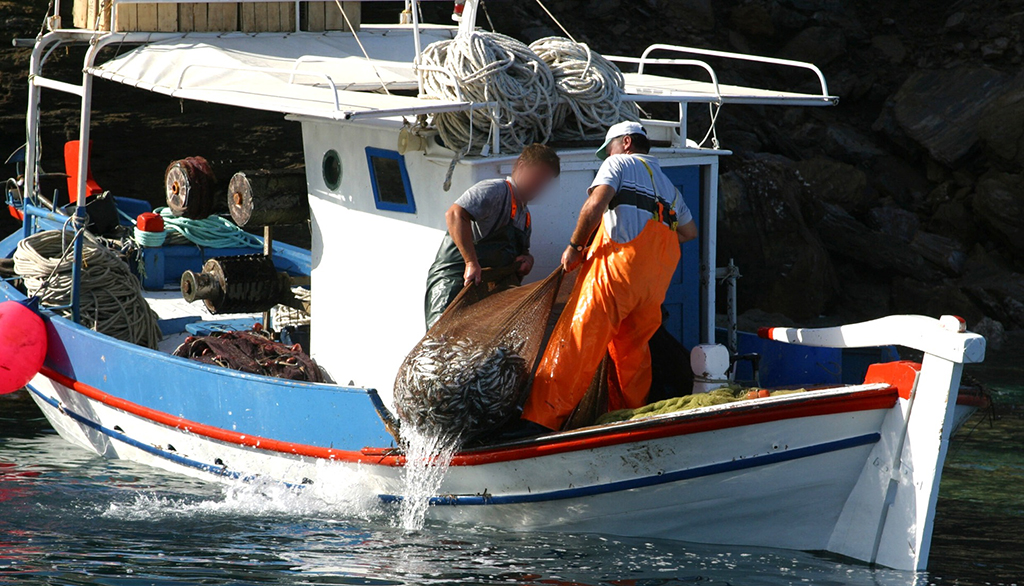
- The winch trawl will be permanently abolished with the new bill of the Ministry of Rural Development, which prohibits its use and its deletion from fishing vessel licences.
- Since 2009, the number of boats using winch trawls has dropped dramatically from 500 to just 73.
- For fishermen withdrawing winch trawls, a financial contribution of EUR 25 000 will be approved, although this will follow a separate procedure.
- The removal of winch trawls is necessary due to the deterioration of fish stocks and its impact on the marine ecosystem.
The winch trawl as a fishing gear is being definitively abolished by means of the draft law of the Ministry of Rural Development ‘Regulation of the fisheries sector, amendment of the Fisheries Code, arrangements for the Schools of Meat Professions, the Register of Farmers and Agricultural Holdings and other provisions’, which is being discussed in Parliament. After almost half a century of gradual restrictions and constant postponements on the complete abolition of the gear, the bill now prohibits the use of winch trawls and provides for their removal from the licences of professional fishing vessels and from the National Fishing Register. Precisely because it is used close to the coast, i.e. in areas that also act as places for the development of juveniles of many species, it is estimated that it affects the development of fish stocks.
Today there are only 73 vessels left that still have this tool, from about 500 vessels in 2009, according to data presented to Parliament by Deputy Minister of Rural Development Thanasis Kavvadas, during the discussion of the bill. A financial contribution of EUR 25 000 will be approved for each of the fishermen obliged to withdraw winch trawls. The aid is not included in the bill under discussion and, as the Deputy Minister clarified, will follow a separate procedure for granting it. The vessels themselves will not be withdrawn and will be able to continue their professional fishing activity with other authorised gear. Indeed, as Mr Kavvadas pointed out, it is possible for vessel owners to receive funding through the ‘Investments in fishing vessels without increasing their fishing capacity’ programme of the 2021-2027 PALYTH to modernise their vessels and continue their activity with other authorised fishing gear.
They're plowing our own seabed
The winch trawl is a towed net, which carries small-sized boats. Fishermen spread it out to sea near the coast and then haul it with ropes and winches towards the boat. As early as 1979, new permits were banned, but it took decades to decide on a total ban. In 2020, an aid of EUR 25 000 for voluntary withdrawal was introduced. Then 101 vessels left, and in 2023 new corresponding aid was given to replace it, thus reaching the current number of only 73 vessels and the complete ban. The conservation of the gear for many years has been accompanied by specific restrictions, closed periods and the exclusion of sensitive habitats, but the collapse of fish stocks in many areas requires drastic measures. However, the deteriorating state of fish stocks calls for drastic measures. "It is not us who are asking for a ban, but the sea itself," said the coastal fishermen.
There are currently only 73 vessels left that still have this gear, up from around 500 vessels in 2009.
Coastal fishing with 10,949 vessels is 96% fishing in Greece. Coastal fishermen agree with the ban but, as they explain, they have also asked the Ministry for the control of recreational fisheries, which however was not included in this bill. Michalis Vayanos, President of the Union of Coastal Fishermen of Rhodes "Poseidon", stresses that the control of recreational fisheries by recording, declaring and controlling catches is also provided for in Article 55 of European Regulation 1224/2009. "Based on Article 55, we consider it necessary that the new Greek legislative framework does not focus exclusively on the control of professional fishermen. The protection of fish stocks requires knowledge of the total quantity removed from the sea, regardless of whether it comes from professional or recreational fishing.
The black market of red coral threatens the Aegean
the bill brings significant changes in the control of professional fishing activity, attempting to create a single framework for surveillance and sanctions. Its provisions redefine the responsibilities of the control authorities and create a Register of Fisheries Controllers and a Register of Fishing Infringements, which will record the infringements and penalties imposed. Electronic monitoring of fishing activity is enhanced through the Integrated Fisheries Monitoring System (OSPA). The system will collect data on fishing vessels, their authorisations and activity, landings and catch quantities, as well as controls and infringements, to facilitate the supervision and traceability of products.
Aquaculture
Provisions relating to aquaculture are included in the bill. “In aquaculture, an integrated framework for fallowing is being created for the first time, with the possibility of temporarily relocating farming facilities to protect and enhance the marine environment. The total Greek aquaculture production is estimated at about 141,000 tons, worth close to 800 million euros, while more than 700 institutions and businesses are active in the sector, with over 10,000 direct and indirect employees," said Deputy Minister of Rural Development Thanasis Kavvadas.
Source: kathimerini.gr




Comments on Article
The comments are for each commenter only. The Democrat does not share these views. We reserve the right to delete any comments we consider offensive or insulting, without any warning. Users who do not comply with the terms of use are excluded.
Reminder:
For the partial reproduction of the news from other websites it is necessary to use the link below to refer to the Democratic article.